
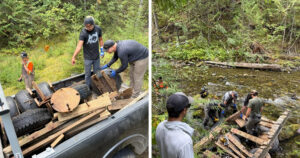
On August 8, 2026, Simpcw First Nation and the Secwépemc Fisheries Commission (SFC) removed 2,100 kg of debris from Dunn Creek after the materials were identified during a fish habitat mapping project conducted by SFC in 2025.
SFC received funding through the British Columbia Salmon Restoration and Innovation Fund (BCSRIF) to map any disturbances to the stream banks and creek bed in the Boulder and Dunn Creek systems.
The Boulder and Dunn Creek systems provide important spawning and rearing habitat for salmon and support the nearby Dunn Lake Hatchery, making the health of the watershed critical to local trout and salmon populations.
During the mapping project, SFC identified two dilapidated docks that had broken free from the lake and became lodged in Dunn Creek upstream of the hatchery. The docks were constructed using tires and other materials that posed a potential risk to salmon habitat and water quality.
“The docks were found in a very important spawning location,” said Jordan Motruk, Fisheries Biologist at SFC. “Both docks were built with tires which have the potential to leach highly toxic compounds into the water. The compounds can be especially harmful to juvenile Coho salmon, but also pose risks to all salmon species.”
While research into tire-derived contaminants in aquatic environments is still emerging, SFC documented the need to remove the structures and included the recommendation in its final report to Simpcw and project funders. Simpcw immediately supported the cleanup effort and provided staff to assist with the removal.
“Dunn Creek itself gets really warm, so every little bit we can do to help the fish, we will do it,” said Tina Donald, Fisheries Manager at Simpcw. “I really appreciate working with the SFC because there are a lot of like-minded people that want to provide a clean environment for our fish.”
Tina said she was surprised to see such a large group there to help.
“That’s what’s great about collaborating with communities and working together,” Jordan said. “Many hands make light work, so it was surprisingly easy to remove all the materials in one day. It felt very fulfilling because we had an immediate, visible, and positive impact on the watershed.”
Removing the debris from the creek helps reduce potential risks to water quality and salmon habitat while protecting a key spawning area. The cleanup also demonstrates how habitat monitoring and restoration projects can identify environmental risks and lead directly to meaningful on-the-ground improvements for salmon and the watershed.